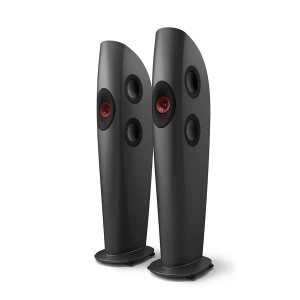


KEF R3 Meta – Stand Mount Bookshelf Speaker
KEF
$1,057.87
(No reviews yet)

Write a Review

KEF
KEF R3 Meta – Stand Mount Bookshelf Speaker
KEF R3 Meta – Stand Mount Bookshelf Speaker
R3 Meta redefines bookshelf speaker's performance. Sharing the same drivers as the range-topping R11 Meta, the R3 Meta is a true three-way design. It has a 12th generation Uni-Q® driver array with MAT™ and a powerful 6.5” hybrid aluminium bass driver that pushes performance to new extremes.
- 12th generation Uni-Q with MAT Metamaterial Absorption Technology (MAT™)
- 25 mm (1 in.) vented aluminium dome tweeter with MAT
- 125 mm (5 in.) aluminium cone midrange
- 165 mm (6.5 in.) hybrid aluminium cone bass driver
- 4 Ω (min. 3.2 Ω) nominal impedance
- 3-way crossover
- Bass reflex ported cabinet
- Single wire or bi-wire inputs
- 58 Hz – 28 kHz (±3 dB) Frequency Response
- 87 dB Sensitivity (2.83 V / 1 m)
- Made in China
- 5 Year Warranty
Highlights & Key Technologies
Metamaterial Absorption Technology (MAT™)
At the heart of the latest R Series is Metamaterial Absorption Technology, a revolutionary innovation that takes the performance of the 12th generation Uni-Q driver array to another level in terms of accuracy and clarity. MAT is a metamaterial absorber disc acoustically coupled to the rear of the tweeter dome; its function is to absorb the rear sound waves radiated by the tweeter dome which would otherwise be a source of distortion when reflected back into the dome. The disc comprises 30 channels of differing lengths, formed into tubes, sharing an opening at the centre of the disc. The tubes act as quarter-wavelength resonators or absorbers, each tuned to a different frequency with a high Q, which effectively absorb a narrow frequency band and its harmonics. The absorption of these channels is tuned to overlap in frequency, leading to almost complete absorption across the spectrum above 620 Hz — well below the lower threshold of the tweeter's working bandwidth. When combined, the channels act as an acoustic black hole, absorbing 99% of the unwanted sound that comes from the rear of the tweeter, eliminating the resulting distortion and providing a purer, more natural acoustic performance. At 11 mm deep, its performance is comparable to a well-designed tapered tube absorber measuring 50 cm long, allowing its inclusion into loudspeakers of any size without taking up significant space in the cabinet. Metamaterial Absorption Technology is a joint development with Acoustic Metamaterials Group.
Coupling MAT to the Tweeter Dome
Of equal importance to the application of MAT is how the back wave is directed into the absorber. This requires a large waveguide opening through the middle of the midrange motor stretching from the back of the tweeter dome to the rear of the midrange motor, where the absorber disc is situated. The conical waveguide's length, angle and opening diameters on both ends are specific to this new Uni-Q, since the acoustic impedance of the waveguide must match that of the opening of the tweeter absorber to avoid a reflection of the wave back into the tweeter dome. The waveguide is a tapered duct with a conical profile which reduces in diameter towards the absorber's opening. The principle is that a spherical wave travelling along a conical horn will avoid reflection at the horn-absorber interface if the interface radius is equal to a quarter of a wavelength of the metamaterial cut-on frequency. This arrangement further allows for an easier accommodation of the absorber into the driver package and reduces the size of the MAT disc itself. In addition, the increase of acoustic volume behind the tweeter due to the presence of the waveguide reduces non-linear distortion associated with the spring effect of compressing the air in this cavity.
12th Generation Uni-Q® Driver Array
The building block of KEF signature sound, Uni-Q technology disperses sound more evenly throughout the room. By placing the tweeter precisely at the acoustic centre of the bass/midrange cone, both act together as a single point source, eliminating the limited 'sweet spot' and instead allowing everybody, no matter where in the room they are sitting, to experience and enjoy the same natural, detailed sound. The Uni-Q technology is designed to significantly improve loudspeaker placement flexibility: it ensures a more coherent and time-aligned sound dispersion, reducing phase issues and improving off-axis response; creates a wider listening sweet spot where high-quality sound is experienced even when not directly on-axis; and enables versatile placement options without compromising sound quality. The bespoke 12th generation Uni-Q driver array with MAT is found in all seven R Series models and is the result of decades of accumulated in-house knowledge and the application of cutting-edge simulation and analysis tools, directly benefiting from the research carried out during the development of the high-performance Uni-Q for the Blade and Reference Meta. Identically sized Uni-Q arrays are deployed across all the R Series models, creating a consistent sound character. In this iteration, the Uni-Q driver array incorporates a new tweeter and tweeter motor with MAT, a completely new midrange motor with a low-distortion split top plate design, KEF's unique Flexible Decoupling Chassis, and a smaller higher-excursion suspension for the midrange driver.
High Frequency Driver & HF Motor System
The stiffened aluminium tweeter dome that sits at the centre of the Uni-Q driver array can deliver a consistently sweet, lucid and lyrical treble at any volume. The front of the stiffened aluminium dome radiates into a small compression chamber loaded by the Tangerine Waveguide, while the rear surface of the dome radiates sound directly into a wide conical waveguide that is acoustically terminated by the acoustic metamaterial absorber, where it is absorbed almost completely. The tweeter motor vent hole, forming a part of the conical waveguide that couples the tweeter dome to the metamaterial absorber, has been maximised to allow the rear sound wave to travel as freely as possible. This required the design of a new motor with a Neodymium magnet and a steel geometry optimised to offer a high force factor to maintain the tweeter sensitivity and high steel magnetic saturation to reduce distortion due to magnetic hysteresis.
Tweeter Gap Damper
Between the tweeter and midrange voice coil an annular gap is formed to allow the free movement of the latter. This gap extends down to the midrange motor and acts like an organ-pipe resonator that is excited by the output of the tweeter, affecting its response. The re-engineered tweeter gap damper strategically places two rings of porous material to tame the resonances and imperfections effectively, thus greatly improving detail and clarity. The Tweeter Gap Damper resides inside a tuned cavity behind the tweeter and is coupled to this gap to reduce the resonance by providing absorption; it expands this annular gap into an acoustic cavity that works as a tuned Helmholtz resonator and then adds acoustic damping to control its resonance. This way the resonance is dissipated and its effect on the tweeter response is reduced.
Tangerine Waveguide & Shadow Flare
The patented Tangerine Waveguide technology manages the airflow to recreate the wide, even spread of a natural sound field, dispersing the pure high-frequency imaging throughout the room. Due to its pistonic motion, the spherical tweeter dome does not produce an even, normal surface velocity across its entire surface; to overcome this, the Tangerine Waveguide works as a phase plug that creates a small, low-compression chamber in front of the dome, allowing it to radiate through nine computer-optimised radial channels. It transforms the axial air particle motion near the diaphragm into a close approximation of a true pulsating sphere at the end of its fins, resulting in a wide and close to constant directivity pattern for the tweeter at high frequencies. The compression chamber has the secondary effect of boosting the tweeter sensitivity from around 7 kHz upwards. Shadow Flare is another feature originally designed for The Reference: a precision designed surface that extends the waveguide effect of the Uni-Q driver array. It reduces harmful cabinet diffraction, meaning the tweeter no longer has line of sight of the cabinet edges, creating a 'shadow region' at the points where the potential for diffraction is highest and minimising the acoustic impact to negligible levels. The Shadow Flare further controls the directivity of the tweeter and recedes the Uni-Q into the enclosure by 5 mm, enough to create an acoustic shadow at the baffle edges closest to the driver, resulting in a substantial reduction in frequency response ripple of both midrange and tweeter.
Ultra-Low Distortion Midrange Motor
The ultra-low distortion midrange motor design uses a copper ring embedded into the motor gap to minimise inductance and variation of inductance with coil position. This lowers the midrange THD and reduces thermal compression, leading to improved efficiency. The motor top plate is an unconventional design consisting of two sections separated by an air gap, with a short voice coil moving within to form an underhung arrangement. Inside the gap, and slightly indented, sits a copper ring aligned with the centre of the voice coil. The split top plate design focuses the magnetic flux available from the motor's ferrite magnet away from the centre of the voice coil towards its ends, creating an M-shaped magnetic flux density profile that decreases around the voice coil's rest position; the resulting force factor is flatter along the voice coil's excursion of +/- 2 mm compared to the previous motor, meaning the force applied to the voice coil more closely follows the applied signal. The motor geometry has been optimised to increase saturation of the steelwork to reduce its magnetic permeability, and the wide copper insert placed within the air gap works as a conductive region coupled to the voice coil, producing an opposing magnetic field that further reduces the ability of the voice coil to magnetise the motor steel. An added benefit of the copper ring being so close to the voice coil is that it efficiently dissipates heat away from it, reducing thermal compression of the signal whilst improving efficiency.
Flexible Decoupling Chassis
Derived from The Reference, the Flexible Decoupling Chassis is incorporated to reduce vibration and colouration. It ensures that any vibrations generated by the mid and high-frequency motor system are not transmitted to the loudspeaker cabinet, while also solving the problem of additional sound created by the driver basket that occurs with traditional decoupling methods. The Uni-Q chassis is constructed of a composite material; while its outer rim is directly attached to the front baffle through a stiff steel plate, the chassis legs incorporate eight flexible spring elements connecting the rigid portion of the structure to the midrange motor. In parallel to the flexible spring elements, a set of four damping material pads provide mechanical damping to the springs. When the mass of the midrange motor vibrates, this vibration is decoupled from the enclosure by the flexible spring elements and quickly dissipated by the damping pads, so the motor vibration cannot leak into the cabinet and be re-radiated as sound into the listening room. Laser vibrometer measurement shows the motor mass resonance around 310 Hz is reduced by more than 30 dB compared to a rigid chassis.
Midrange Suspension & Cone Neck Decoupler
The suspension centres the voice coil in the magnetic gap and provides a high restoring force that protects the voice coil from damage at extreme displacements. The suspension profile has been redesigned to reduce its width to 0.69 cm (0.27”), decreasing its mass and increasing its resonant frequency out of the passband while still allowing a linear excursion of more than +/- 2 mm, eliminating the dip at 950 Hz caused by suspension resonance. The surround on the 12th generation Uni-Q driver array allows for longer excursion without causing diffraction and extending the frequency range of the midrange, and the contours of tweeter dome, midrange cone and surround are all computer-optimised to ensure a perfectly smooth transition to the cabinet. The midrange cone is made from an aluminium alloy to ensure low mass and high rigidity, resulting in pistonic behaviour throughout the passband; to avoid the break-up peaks typical of aluminium midrange cones, a lossy interface between the voice coil and the cone called the Cone Neck Decoupler has been tuned to decouple them just below the break-up frequency.
True Bass Definition
Bass is a vital element of performance, and the low-frequency drivers of the R Series have been engineered with acute care and precision. They are built using a two-part structure, where a shallow concave aluminium skin sits atop a paper cone. This stiffness combined with the cone's unique geometry reduces unwanted resonances and delivers the pistonic movement that makes these drivers time so well. The angle and coupling radius are optimised to push the first break-up frequency as high as 2.3 kHz, by which point the driver output is attenuated more than 30 dB with respect to the system output. A sizeable 50 mm (2”) voice coil is employed for high power handling. The motor employs a highly saturated undercut pole design to reduce inductance and its associated distortion, and a wide central vent to reduce turbulence noise and acoustic loading from the air trapped inside the voice coil. The drivers' magnet system creates a broad, uniform magnetic field, while the suspension reduces harmonic distortion for a clean, precise sound. The surround is a linear-excursion inverted half-roll design that reduces the effect of diffraction for the neighbouring Uni-Q by not protruding from the speaker baffle. The R3 Meta shares the same drivers as the range-topping R11 Meta.
Flexible Port for Cleaner Bass
When it comes to listening to music through a speaker, it should only be the drivers we hear, not the resonances or turbulence created by a bass port. The R Series' ports feature innovative flexible walls. Using computational fluid dynamics, the flare and profile of each port is calculated to delay the onset of turbulence, while the flexible port walls prevent longitudinal resonances from colouring the midrange. The wall of the tubular port section is made from a flexible rubber that allows the wall to expand with the acoustic pressure of the port resonances; since rubber has high internal damping, it dissipates energy away from these resonances, reducing the acoustic output of the port resonances while the low-frequency behaviour of the port remains unaffected. In the R Series, the ports are located on the back of the enclosure so that their internal opening can be freely positioned in locations that minimise the leakage of internal acoustic resonances. The advantages of this approach are twofold: better bass, and cleaner sound further up the frequency range in the vital lower midrange area. Supplied port bungs allow the loudspeaker's bass characteristics to be customised to the listening environment.
Performance Critical Damping
Powerful drivers can easily cause the cabinet walls to make noise of their own — noise that was never in the recording in the first place. Working alongside the bespoke internal bracing layout, KEF's Constrained Layer Damping is a sophisticated bracing system that ensures the cabinet stays inert by connecting the bracing to the drivers and cabinet by a lossy interface. This material converts vibration into heat, ensuring that the cabinet makes the only sound it needs to — the sound of silence. The approach uses the cabinet braces as the constraining top layer while a layer of viscoelastic damping material is used only in the interface area between the panels and the braces; this layout outperforms lining the entire inside area of the panels while making more efficient use of the material. The arrangement and type of acoustic damping material inside the midrange and low frequency cavities has been re-optimised to dampen standing waves, resulting in a perceivable sonic enhancement in the clarity of the upper bass and midrange; for the R Series with MAT the midrange acoustic damping has been changed from BAF wadding to high-density Ethylene-vinyl acetate (EVA) copolymer foam to further increase damping of the sharp resonance around 1.5 kHz.
Enhanced Crossover Design
The primary role of a crossover filter network is to combine the output of the different drivers such that the transition between them is smooth in magnitude and phase and that they work in their intended frequency range away from damage and distortion. A secondary but equally important function is to ensure this smooth transition occurs in all directions, not only on the speaker's frontal axis. The topology used across the series is a three-way network; it simplifies the tweeter filter to improve the system's directivity and uses a single series capacitor in the midrange branch. The tweeter series capacitor has been upgraded to a better design Polypropylene film one with a thicker film, lower resistance contact layer (schoopage), lower resistance terminals and a thicker outer damping layer. Where possible, air core inductors have been used, and all cored inductors have a laminated steel core of a specially selected grade to reduce THD. The R3 Meta is a special case within the range as the LF section does not form a symmetrical arrangement around the Uni-Q, since it has only one LF driver; for this reason the Uni-Q is mounted close to the top edge of the enclosure, and the crossover approach allows a dip in the axial response, prioritising a smooth power average.
Connections
The loudspeakers can be connected to an amplifier with single wire or bi-wire connections. In a single wire connection, a standard loudspeaker cable with two conductors is used. Bi-wire connections use two separate loudspeaker cables for each loudspeaker: at the loudspeaker end, one pair of the cables connects to the high-frequency (HF) terminals, and the other pair connects to the low-frequency (LF) terminals. To enable single wire connections, the Link connection knobs are rotated clockwise until fully tightened and the yellow rings at the base of the knobs cannot be seen; to enable bi-wire connections, the knobs are rotated anticlockwise until the yellow rings fully reveal. Bi-amplification is also possible — a setup method using two separate amplifiers or amplifier channels to power different drivers within a loudspeaker. If connecting with banana plugs, the plastic caps at the binding posts must be removed by fully unscrewing the metal caps on the connectors.
Microfibre Grilles
The dedicated microfibre grilles feature 1,801 precision-cut holes for each driver, delivering uncompromised sonic performance even when the drivers are covered. Compressed with heated pressure from multiple layers of material, they have a tactile, suede-like feel, and the edges are burnished. The magnetic fixings provide a secure and precise fit in keeping with the clean styling of the speakers themselves. The R Series has been engineered to perform with or without grilles.
Design, Finishes & Mounting
At KEF innovative engineering goes hand-in-hand with great design, and the product design team strives to create deceptively simple, elegant loudspeakers. This understated design aesthetic is complemented by carefully selected colour options, conceived to be at home in either traditional or modern interiors. The R3 Meta is available in Black Gloss, White Gloss, Walnut, and an exclusive Indigo Gloss Special Edition. The R3 Meta also features threaded inserts that allow the speaker to be mounted securely onto the top of the S3 Floor Stands (sold separately), which boast integrated cable management and a mass-loadable column. Bookshelf loudspeakers should always be placed on shelves or stands and not directly on the floor; a stand of 497 mm (19.5”) aligns the Uni-Q driver with the other R Series floorstanding speakers. Supplied rubber feet help to decouple the loudspeakers from their contacting surfaces, isolating vibrations from transmitting between the loudspeakers and nearby furniture and objects. Customised feet with M8 Pitch 1.25 15 mm specifications fit the R3 Meta.
Details & Specifications
MODEL INFORMATION
Model: R3 Meta
Design: Three-way bass reflex
DRIVE UNITS
Uni-Q Driver Array:
HF: 25 mm (1 in.) vented aluminium dome with MAT
MF: 125 mm (5 in.) aluminium cone
Bass Unit:
LF: 165 mm (6.5 in.) hybrid aluminium cone
PERFORMANCE
Crossover frequency: 420 Hz, 2.3 kHz
Frequency range (-6 dB): 38 Hz – 50 kHz
Typical in-room bass response (-6 dB): 30 Hz
Frequency response (±3 dB): 58 Hz – 28 kHz
Harmonic distortion (90 dB, 1 m): < 1 % 73 Hz and above; < 0.5 % 90 Hz – 20 kHz
Maximum output: 110 dB
Amplifier power (recommended): 15 – 180 W
Nominal impedance: 4 Ω (min. 3.2 Ω)
Sensitivity (2.83 V / 1 m): 87 dB
PHYSICAL SPECIFICATIONS
Weight: 12.4 kg (27.3 lbs) — measurement per unit
Dimensions (H x W x D) with terminals: 422 × 200 × 336 mm (16.6 × 7.9 × 13.2 in.) — measurement per unit
Finishes: Black Gloss / White Gloss / Walnut / Indigo Gloss Special Edition
INSTALLATION
Screw thread (stand mounting): M8 (1.25 mm pitch)
Screw hole depth: 18 mm
Customised feet specification: M8 Pitch 1.25 15 mm
Recommended stand height for Uni-Q alignment with floorstanding models: 497 mm (19.5”)
Recommended stand height range: 450 – 600 mm (18” – 24”)
Recommended minimum distance to front wall: 225 mm (9”)
Recommended minimum distance to side wall: 0.5 m (20”)
Paint type: Polyester paint or acrylic paint
CABLE GAUGE AND LENGTH (4 Ω NOMINAL IMPEDANCE)
18 AWG (0.823 mm²): 4.9 m / 16 ft
16 AWG (1.31 mm²): 7.3 m / 24 ft
14 AWG (2.08 mm²): 12.2 m / 40 ft
12 AWG (3.31 mm²): 18.3 m / 60 ft
10 AWG (5.26 mm²): 30.5 m / 100 ft
GENERAL
Country of Manufacture: Made in China
Warranty: 5 Year Warranty
WHAT IS IN THE BOX
1 pair of R3 Meta loudspeakers
1 pair of microfiber grilles
Rubber feet
Port bungs
User manual and warranty information