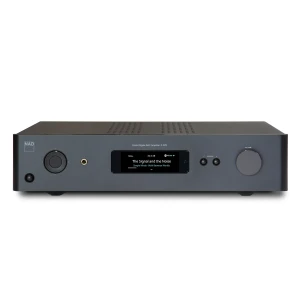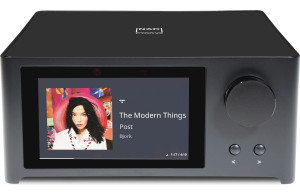


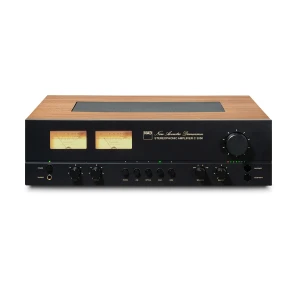

NAD C 389 BluOS® – Streaming Integrated Amplifier
NAD
$2,157.22
(No reviews yet)

Write a Review

NAD
NAD C 389 BluOS® – Streaming Integrated Amplifier
NAD C 389 BluOS – HybridDigital DAC Streaming Integrated Amplifier
The NAD C 389 BluOS HybridDigital DAC Streaming Integrated Amplifier combines award-winning HybridDigital amplification with the acclaimed BluOS high-resolution streaming platform and Dirac Live Room Correction — all in a single integrated component. Its 130-Watt-per-channel UcD design delivers clean, controlled power across all listening levels, while the installed MDC2 BluOS-D module provides access to hundreds of internet radio stations and over 20 streaming services, whole-home audio integration across up to 64 zones, and Dirac Live room correction up to 500 Hz with a supplied calibrated microphone. HDMI eARC, a precise MM phono stage, and versatile digital and analogue inputs complete a refined, future-ready foundation for everyday listening.
- Class D HybridDigital UcD amplifier topology
- 130 W per channel, continuous (8Ω and 4Ω)
- THD <0.02% (8Ω and 4Ω, 20 Hz – 20 kHz)
- BluOS streaming platform via installed MDC2 BluOS-D module; Wi-Fi and Ethernet
- Up to 24-bit/192 kHz via BluOS
- Tidal Connect, Spotify Connect, Qobuz, Roon Ready, Apple AirPlay 2, Amazon Alexa, Google Assistant; MQA decoding and rendering
- Dirac Live Room Correction (Limited Bandwidth, 20 Hz – 500 Hz); full-bandwidth upgrade available; calibrated microphone included
- Moving Magnet (MM) phono stage with infrasonic filtering
- Two-way Qualcomm aptX HD Bluetooth (via MDC2 BluOS-D)
- Dedicated headphone amplifier, 1/4" (6.3 mm) output
- Made in China
- 2 Year Warranty
Highlights & Key Technologies
HybridDigital UcD Amplification
The C 389 BluOS uses NAD's HybridDigital UcD design to deliver 130 Watts per channel of clean, controlled power. Its balanced bridged amplifier modules and efficient power supply maintain clarity and composure when the music becomes more energetic, providing an engaging presentation that brings out more detail and presence in every track. The UcD design maintains wide bandwidth, flat frequency response, high current capability, and stability into demanding low-impedance speaker loads, with noise and distortion remaining extremely low across all operating conditions.
Digital Architecture & DAC
A high-performance digital-to-analogue stage ensures wide dynamic range, low noise, and accurate imaging across all sources, revealing subtle textures and spatial cues for clear, expressive playback. Digital inputs support audio up to 24-bit/192 kHz (per manual); up to 32-bit/384 kHz (per product page).
BluOS Streaming via MDC2 BluOS-D
The C 389 BluOS includes the MDC2 BluOS-D module, which adds the BluOS high-resolution multi-room streaming platform via Wi-Fi and Ethernet. The BluOS Controller app — available for iOS, macOS, Android, and Windows — provides access to hundreds of internet radio stations and over 20 streaming services, including several that deliver lossless and high-resolution audio up to 24-bit/192 kHz. Supported services and integrations include Tidal Connect, Spotify Connect, Qobuz, Roon Ready, Apple AirPlay 2 with Siri voice control, Amazon Alexa voice control, Google Assistant voice control, and MQA decoding and rendering. The MDC2 BluOS-D also incorporates two-way Qualcomm aptX HD Bluetooth. A USB port allows playback from a connected USB drive. Thanks to MDC2's bidirectional architecture, audio from any source connected to the C 389 BluOS can be shared with up to 63 additional BluOS-enabled components on the same network, for whole-home audio in up to 64 zones. Playback can also be controlled from smart home systems including Crestron, Control4, Lutron, RTI, and others.
Dirac Live Room Correction
The MDC2 BluOS-D includes a license for Dirac Live Room Correction (Limited Bandwidth, 20 Hz – 500 Hz), with the option for advanced users to upgrade to the Dirac Live Full Frequency version. Dirac Live analyses the listening space using the supplied calibrated microphone and applies correction filters to the MDC2 BluOS-D module, improving bass clarity, imaging, and tonal accuracy. The module can store up to five Dirac profiles for different listening positions or room conditions. Thanks to MDC2's two-way architecture, Dirac Live room correction applies to all sources connected to the C 389 BluOS, not only streamed content.
Analogue Inputs & MM Phono Stage
Two pairs of RCA line-level inputs feature low-noise buffer amplifiers to prevent sonic degradation. The dedicated MM phono stage delivers ultra-precise RIAA equalization, extremely low noise, and high overload margins. An innovative circuit suppresses the infrasonic noise present on all LPs without compromising bass response. Analog bypass mode keeps analog signals in the analog domain without analog-to-digital conversion, with tone control functions remaining operative.
Digital Inputs & HDMI eARC
The C 389 BluOS provides two optical and two coaxial digital inputs. The HDMI eARC port allows audio from a connected TV to be played through the C 389 BluOS — including control of amplifier output via the TV's remote using HDMI CEC. eARC is the default mode and falls back to ARC if no eARC connection is established. Only audio output from a connected TV is supported by the HDMI eARC port; there is no video output.
Outputs, Headphone Amplifier & MDC2 Platform
The C 389 BluOS provides two sets of speaker terminals (Speaker A and Speaker B, operating in parallel), dual subwoofer outputs, and a preamplifier output. The dedicated headphone amplifier features a low output impedance of 2.2 ohms, enabling the C 389 BluOS to drive headphones of any impedance; inserting a headphone jack automatically switches off the speaker, pre-out, and subwoofer outputs. The second MDC2 slot remains available for future upgrade modules. Tone controls (bass, treble ±7 dB, and balance) and a volume control with variable or fixed (cinema bypass) mode are provided.
Control & Integration
The C 389 BluOS includes RS-232 serial port, 12V trigger input and output, and IR input and output for use with IR repeater and multi-room systems. NAD is a certified partner of AMX and Crestron. The included SR 10 remote control handles key functions and can be programmed to control up to four devices.
Details & Specifications
All specifications measured according to IHF 202 CEA 490-AR-2008 standard. THD measured using AP AUX 0025 passive filter and AES 17 active filter.
PREAMPLIFIER – LINE INPUT, PRE-OUT (ANALOG BYPASS ON)
THD (20 Hz – 20 kHz): <0.002% at 2 V out
Signal-to-Noise Ratio: >106 dB (per product page); >100 dB (per manual) (IHF; A-weighted, ref. 500 mV out, unity gain)
Channel separation: >100 dB (1 kHz); >90 dB (10 kHz)
Input impedance (R and C): 56 kΩ + 100 pF (per product page); 56.2 kΩ + 100 pF (per manual)
Maximum input signal: >4.6 Vrms (per product page); >2.35 Vrms (per manual) (ref. 0.1% THD)
Output impedance: Source Z + 320 Ω (per product page); Source Z + 330 Ω (per manual)
Input sensitivity: 65 mV (per product page); 257 mV (per manual) (ref. 500 mV out, Volume maximum)
Frequency response: ±0.3 dB (20 Hz – 20 kHz)
Maximum voltage output – IHF load: >5 V (per product page); >4.5 V (per manual) (ref. 0.1% THD)
PHONO – PHONO INPUT, PRE-OUT (ANALOG BYPASS ON)
Cartridge compatibility: Moving Magnet (MM) only
THD (20 Hz – 20 kHz): <0.02% at 2 V out
Signal-to-Noise Ratio: >84 dB (per product page); >80 dB (per manual) (200 Ω source; A-weighted, ref. 500 mV out)
Input impedance (R and C): 46 kΩ / 100 pF
Input sensitivity: 4.2 mV (per manual) (ref. 500 mV out, Volume maximum)
Frequency response: ±0.3 dB (20 Hz – 20 kHz)
Maximum input signal at 1 kHz: >80 mVrms (per product page); >38.8 mVrms (per manual) (ref. 0.1% THD)
HEADPHONE – LINE INPUT, HEADPHONE OUT (ANALOG BYPASS ON)
THD (20 Hz – 20 kHz): <0.005% at 1 V out
Signal-to-Noise Ratio: >107 dB (per product page); >98 dB (per manual) (32 Ω loads; A-weighted, ref. 1 V out, unity gain)
Frequency response: ±0.3 dB (20 Hz – 20 kHz)
Channel separation: >62 dB (1 kHz)
Output impedance: 2.2 Ω
Output connector: 1/4" (6.3 mm) stereo jack
AMPLIFIER – LINE IN, SPEAKER OUT (ANALOG BYPASS ON)
Continuous output power into 8Ω and 4Ω: 130 W (ref. 20 Hz–20 kHz at rated THD, both channels driven)
THD (20 Hz – 20 kHz): <0.02% (250 mW to 130 W, 8Ω and 4Ω (per product page); 1 W to 150 W, 8Ω and 4Ω (per manual))
Signal-to-Noise Ratio: >85 dB (A-weighted, 500 mV input, ref. 1 W out in 8Ω)
Clipping power: 150 W (per product page); >160 W (per manual) (at 1 kHz, 0.1% THD)
IHF dynamic power: 8Ω: 210 W (per product page); 228 W (per manual) | 4Ω: 440 W | 2Ω: 290 W
Peak output current: >26 A (per product page); >20 A (per manual) (in 1Ω, 1 ms)
Damping factor: >150 (per product page); >140 (per manual) (ref. 8Ω, 20 Hz to 6.5 kHz)
Frequency response: ±0.3 dB (20 Hz – 20 kHz)
Channel separation: >90 dB (1 kHz)
Input sensitivity (for 130 W in 8Ω): Line In: 201 mV (per product page); 301 mV (per manual) | Digital In: 10.25% FS (per product page); 14.65% FS (per manual)
GENERAL SPECIFICATIONS
Digital input bit rate / sample rate support: up to 24-bit/192 kHz (per manual); up to 32-bit/384 kHz (per product page)
BluOS maximum streaming resolution: up to 24-bit/192 kHz
Bluetooth frequency band: 2.402 GHz – 2.480 GHz (MDC2 BluOS-D)
Bluetooth codec: Qualcomm aptX HD (two-way, via MDC2 BluOS-D)
Network standby power: 0.6 W
Auto standby power: <0.5 W
INPUTS
Optical digital: 2 (TOSLINK)
Coaxial digital: 2 (RCA)
HDMI: 1 (eARC/ARC)
Analogue line: 2 (RCA pairs)
Phono: 1 (MM, RCA pair with ground terminal)
USB (MDC2 BluOS-D): 1 (for local USB drive playback)
Bluetooth: Yes (two-way, Qualcomm aptX HD, via MDC2 BluOS-D)
Wi-Fi / Ethernet: Yes (via MDC2 BluOS-D)
OUTPUTS
Speaker terminals: 2 sets (A and B, operating in parallel)
Subwoofer: 2 (RCA)
Preamplifier: 1 (RCA pair)
Headphone: 1 (1/4" / 6.3 mm stereo jack)
STREAMING & ROOM CORRECTION (MDC2 BluOS-D)
Streaming platform: BluOS
Supported services: Tidal Connect, Spotify Connect, Qobuz, Roon Ready, Apple AirPlay 2, Amazon Music HD, Deezer, and others
Voice control: Apple Siri (via AirPlay 2), Amazon Alexa, Google Assistant
MQA: Decoding and rendering supported
Multi-room zones: Up to 64 (1 host + up to 63 additional BluOS-enabled components)
Room correction: Dirac Live Limited Bandwidth (20 Hz – 500 Hz); full-bandwidth upgrade available
Dirac profiles stored: Up to 5
Calibrated microphone: Included
CONTROL & CONNECTIVITY
RS-232: Yes (serial port)
IR In / IR Out: Yes
12V Trigger In / Out: Yes
MDC2 expansion slots: 2 (1 occupied by MDC2 BluOS-D; 1 remaining)
DIMENSIONS & WEIGHT
Gross dimensions (W × H × D): 435 × 100 × 390 mm (17 1/8 × 4 × 15 3/8 inches)
Net weight: 8.7 kg (19.1 lb) (per product page); 8.7 kg (19.2 lbs) (per manual)
Shipping weight: ~11 kg (24.2 lb) (per product page); 11 kg (24.3 lbs) (per manual)
INCLUDED ACCESSORIES
SR 10 remote control with 2 AA batteries
Two detachable mains power cords
Bluetooth antennas
MDC2 BluOS-D module (installed)
Calibrated microphone assembly with USB MIC Sound Adaptor (for Dirac Live setup)
COUNTRY OF MANUFACTURE & WARRANTY
Country of Manufacture: China
Warranty: 2 Years